
Jefferson County Court Records After Arrest
Jail booking and court filing are related, but they are not the same record. After an arrest in Jefferson County, the person may be booked at the Jefferson County Detention Facility. That booking can create a current inmate record and bond information. The court record begins when the Colorado First Judicial District Attorney's Office files charges and the case moves through Jefferson Combined Court or another proper court division.
JCSO states that it does not maintain court records and directs users to the Colorado Judicial Branch. Use jail inmate records for current custody and booking routes, and use jail roster mugshots for booking-photo questions. Court records after a jail arrest are the filed complaint, information, indictment, docket events, charge status, bond orders, warrants tied to the case, disposition, and sentencing record.
Find Jefferson County Court Records After Arrest
The official starting point is the Colorado Judicial Branch docket search. Jefferson County is in the 1st Judicial District, and the local courthouse is Jefferson Combined Court. The docket tool is hearing and docket focused, not a full case-document repository. It requires at least one filter in addition to date, so a name, county, court, case class, case number, or attorney filter is often needed.
- Search the JCSO current inmate lookup first if custody or bond status is the immediate question.
- Open the Colorado Judicial Branch docket search and choose Jefferson County or the 1st Judicial District.
- Search by defendant name, case number, courthouse, court type, or another available filter.
- Review docket entries for hearings, charge status, bond events, disposition, and sentencing notes.
- Call Jefferson Combined Court records if the docket does not show the document or copy needed.
For a statewide criminal-history summary, the CBI Internet Criminal History Check is a separate Colorado-only channel. It is not the court file, and each downloaded result carries its own fee. Missing or unknown dispositions must be corrected with official court or agency documentation.
The Colorado docket search screenshot shows the search filters that matter after a Jefferson County arrest.
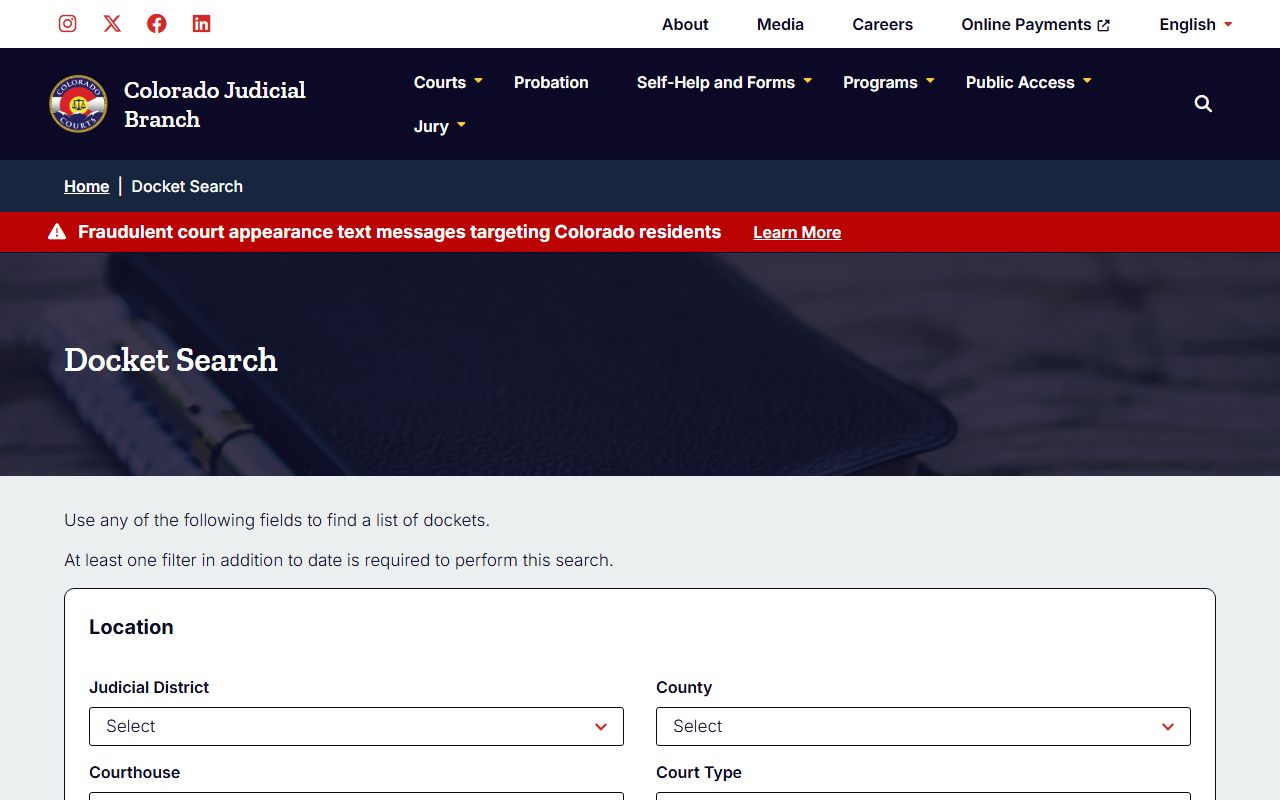
Those filters are useful for locating hearing records, but certified filings and copies still route through court records staff.
Jefferson County Court Search Fields
The state docket form gives several ways to narrow court records after an arrest. Criminal users should pay attention to judicial district, county, courthouse, court type, party name, and case-number fields. Case-class choices can include criminal, misdemeanor, traffic, juvenile, and other civil or probate options. The correct class depends on the filed case, not just the arresting agency's first booking label.
| Field | Type | Use |
|---|---|---|
| Judicial District | Dropdown | Choose 1st Judicial District for Jefferson County. |
| County | Dropdown | Choose Jefferson County when searching local cases. |
| Courthouse | Dropdown | Jefferson Combined Court is the main local court. |
| Court Type | Dropdown | County, District, or Both. |
| Party Search | Name fields | Use defendant first and last name for individual party search. |
| Case Number | Year, class, sequence | Use when paperwork or counsel provides a case number. |
Charges Filed After a Jail Arrest
Colorado criminal-procedure definitions in C.R.S. 16-1-104 help separate the arrest from the filed court case. The jail may list arrest or booking charges tied to intake and bond. The prosecutor's filed charge becomes the court record and may be different, reduced, added, or dismissed as the case moves.
| Document | Plain Meaning | Why It Matters |
|---|---|---|
| Complaint | A charging document that starts or supports a criminal case. | Often used early in the process and tied to probable cause. |
| Information | A prosecutor-filed charge document. | Common route for formal filed charges after review. |
| Indictment | A charge returned through a grand jury process. | Used in some serious or complex cases. |
Jefferson County Charge Status
Charge status changes are common after a jail arrest. The District Attorney may file a different charge than the arresting agency listed at booking. A charge can be amended, reduced, added, dismissed, or resolved by plea or verdict. A docket entry should be read with the hearing date and court division because one case can have multiple charges at different stages.
| Status | What It Means |
|---|---|
| Pending | The charge remains open and has not reached final disposition. |
| Amended or reduced | The filed charge changed, often after prosecutor review, plea talks, or court rulings. |
| Dismissed | The court record shows that charge was dropped or closed without conviction. |
| Convicted | The charge resulted in a guilty plea, verdict, or other conviction entry. |
| Deferred or alternative resolution | The case may have conditions before final dismissal or conviction treatment. |
Bond Records After Arrest
JCSO says bond may be posted at the Jefferson County Detention Facility at any time, and bond amounts are set by the court. Bond information can be found through the inmate lookup or by calling 303-271-5444. For bond fund returns, JCSO routes users to Jefferson County Courts at 720-772-2500. Release processing typically takes 2 to 6 hours after the release order is received, but holds, paperwork, identity, transport, and other legal requirements can affect timing.
| Bond Type | How It Works in Jefferson County |
|---|---|
| Cash bond | The full amount is paid in cash, cashier's check, or money order. |
| Surety bond | A licensed bail bondsman posts the bond, with JCSO noting typical fees of 10 to 15%. |
| Personal recognizance | The court orders release without cash payment, subject to court criteria and conditions. |
| PR with co-signer | A co-signer guarantees the person's appearance under the court order. |
| Credit-card bond | TouchPay handles credit or debit card payment, with separate processing fees. |
Note: C.R.S. 16-4-102 says booking fees and other debts do not need to be paid to secure release on a money bond.
Warrants Before Court Records
Some court records after a jail arrest begin with a warrant. JCSO did not publish a public online warrant search form in the research. The Warrants Unit handles Jefferson County warrant questions by phone at 303-271-6475, Monday through Friday, 8:00 a.m. to 5:00 p.m. Callers should have the full legal name and date of birth ready. JCSO can provide information about Jefferson County warrants only.
An arrest warrant can be felony or misdemeanor and may or may not have bond set. A bench warrant often follows failure to appear or violation of a court order. A search warrant is different because it authorizes a search of places or items and is not served on a person like an arrest warrant. If a person is booked on a warrant, the current-custody lookup may show them after booking, but the lookup is not a warrant database.
Charges vs Convictions
An arrest and a filed charge are not a conviction. The court record may show allegations, amended charges, dismissed counts, pleas, verdicts, and sentences. CBI criminal-history results can also show missing or unknown dispositions until corrected by court or agency paperwork. Treat each label as a stage in the case, not as a final moral or legal conclusion.
| Charge | Conviction | |
|---|---|---|
| Meaning | A prosecutor's accusation filed in court. | A guilty plea, verdict, or conviction entry. |
| Timing | After arrest and prosecutor review. | After plea, trial, or qualifying disposition. |
| Can change? | Yes, charges may be amended, reduced, added, or dismissed. | Can be appealed, sealed, or affected by later court orders when law allows. |
Sealed vs Expunged Records
Colorado sealing and expungement are court-controlled record access processes. The Colorado Legislative Council's sealing and expungement memo explains that eligibility depends on the record type, disposition, waiting period, and statutory route. A sealed case may be hidden from ordinary public access but still exist for limited official uses. Expungement is narrower and often tied to juvenile or specific statutory categories.
| Sealed | Expunged | |
|---|---|---|
| Public visibility | Usually hidden from public search after court order. | Treated more like erased from public access under the specific statute. |
| Official access | Some law-enforcement, court, or licensing access may remain. | Depends on the expungement statute and record type. |
| Common route | Petition or automatic process when Colorado law allows. | Limited categories, often juvenile or specific eligible records. |
Background Check Boundaries
Casual court lookup, jail custody search, and employment or tenant screening are different tasks. The Colorado docket can help locate court dates and case activity. JCSO records can provide sheriff booking and release records when releasable. CBI ICHC provides a Colorado-only criminal-history channel. Any employment, housing, credit, insurance, or similar screening must use lawful FCRA-compliant processes and authorized consumer reporting channels.
Important: These pages are not consumer reports and cannot be used for FCRA-covered screening decisions.
Restricted Jefferson County Court Records
Not every court record after an arrest is public online. Juvenile arrests, sealed cases, expunged records, victim information, protected witness details, active investigation material, and some dismissed or restricted matters can be withheld or redacted. JCSO also states that it does not maintain court records, statewide criminal-history records, sealed or expunged records, juvenile records, and active investigation materials through ordinary sheriff records channels. Older or protected court files may require direct contact with Jefferson Combined Court records staff.